 script monkey: business solutions using digital intelligence
 Why a new report on Anthropic automating AI development is alarming researchers
Anthropic is using AI to build more powerful AI. And it appears to be working remarkably well, with the company's models improving roughly twice as quickly as a year ago, with little indication of slowing down. That's according to a new report published Thursday by the AI safety research organization METR, following an 11-week investigation […]
// what caught our eye
Videos, posts and articles from around the web that we thought were worth a look. Every link opens on its own site.
November 2026
Why a new report on Anthropic automating AI development is alarming researchers
Anthropic is using AI to build more powerful AI. And it appears to be working remarkably well, with the company's models improving roughly twice as quickly as a year ago, with little indication of slowing down. That's according to a new report published Thursday by the AI safety research organization METR, following an 11-week investigation […]
 Gigantic chasm on Mars is still tectonically active
New research shows that a powerful 2021 marsquake emanating from Valles Marineris — the largest canyon in the solar system — was triggered by unexpected movement in a fault line deep below the gigantic structure, revealing that tectonic activity can still occur on geologically "dead" worlds.
 Robot moth grows new sensor using its own blood
Robots usually leave the factory with every sensor they'll ever have bolted on. But what if they could grow new ones when needed? Scientists have now built a moth-shaped robot that uses chemicals in its artificial blood to do just that. Continue Reading Category: Robotics , Engineering Tags: Self-Assembly , Soft Robotics , Sensors , Robots , 3D Printing , University of Tartu , Italian Institute o…
 Scientists find the best evidence yet of potentially habitable volcanic vents on Mars
Magma and a possible environment for ancient life might be present on Mars in the region of a large volcano on the Red Planet.
 A cosmic 'leaf blower': Light-propelled winds help explain early universe's bright galaxies
When astronomers looked at photos of the early universe taken by the James Webb Space Telescope, they found something odd: an overabundance of bright galaxies. Based on what they knew about the early universe, such galaxies should have been far less common in the few hundred million years following the Big Bang.
Image:
NASA Goddard Photo and Video, CC BY 2.0
 Physicists step closer to the 'Zeptoverse' after 42-year particle search
Physicists have found evidence of a particle decay so rare that it is expected to occur only around once in every 10 billion "beauty" particles. The result, from the upgraded LHCb experiment at CERN's Large Hadron Collider (LHC), follows a search spanning more than 40 years and brings physicists closer to exploring the "Zeptoverse"—an unexplored world that exists at distances of a billionth of a…
 All 5 genetic “letters” of DNA and RNA discovered in a 4.5-billion-year-old asteroid
Scientists have discovered all five essential nucleobases used in DNA and RNA in pristine samples from asteroid Ryugu, revealing that key ingredients for life existed in space billions of years ago. The remarkable finding adds to growing evidence from other asteroids and meteorites that these molecules were widespread throughout the early Solar System.
 JWST may have found where heavy black hole seeds formed
Astrophysicists think that the supermassive black holes (SMBH) we see in the modern universe are the result of a long, drawn-out process. That process is referred to as the hierarchical black hole mergers framework. It explains how some SMBHs can reach such staggering masses. Some of the most massive appear to have billions of solar masses.
 Scientists say a forgotten particle may explain why the universe exists
A mysterious particle overlooked for decades may hold the key to why matter survived the Big Bang, allowing stars, planets, and life to exist. Scientists believe this forgotten neutrino reshaped the early universe and may have left detectable gravitational wave signals that could help unlock the cosmos’s deepest mysteries.
 IceCube detects ghost particles with 10 billion times the energy of solar neutrinos
Mysterious particles called neutrinos constantly stream through our bodies, and scientists are now detecting incredibly powerful versions arriving from distant cosmic sources using a massive observatory buried in Antarctic ice. These elusive “ghost particles” could hold extraordinary clues about the Big Bang, extreme cosmic events, and some of the universe’s greatest mysteries.
 Anthropic warns that it's very close to RSI capability, aka self-building AI | TechCrunch
RSI is the point at which AI grows so good at training itself that it spawns a dramatic acceleration of AI capabilities. To the AI doomers, RSI represents the cataclysm from which there is no return.
October 2026
 Einstein's equations may explain the universe without dark energy
Mathematicians have uncovered what they argue is a fundamental flaw in the standard model of the universe, potentially challenging the need for dark energy. Their calculations suggest that the mathematical framework used to describe cosmic expansion is inherently unstable and that the universe could accelerate naturally under Einstein's original theory of gravity. The findings also raise surprisi…
 Scientists confirm global warming is accelerating faster than ever recorded
Earth is warming faster than ever recorded, with scientists detecting a major acceleration in global temperatures since around 2015. A new study reveals that the warming rate has surged to approximately 0.35°C per decade, nearly double the average pace observed from 1970 to 2015. After removing natural climate fluctuations, researchers confirmed the acceleration with more than 98% statistical con…
 Bright object beyond Pluto may be the solar system's sixth dwarf planet
The Vera C. Rubin Observatory has found what might be a new dwarf planet in our solar system, orbiting the sun on an inclined plane past Pluto.
 Unannounced Test by Controversial “Sunlight-as-a-Service” Space Startup Shocks Astronomers
"This is not a 'concern' — this is like a bullet in your head. It’s the end of ground-based astronomy." The post Unannounced Test by Controversial “Sunlight-as-a-Service” Space Startup Shocks Astronomers appeared first on Futurism .
 CRISPR Prime Editing Rewrites DNA in the Human Body for the First Time
The first patient received a dose of the high-precision gene editor in a new clinical trial for Wilson disease. Researchers hope it's a one-and-done fix. The post CRISPR Prime Editing Rewrites DNA in the Human Body for the First Time appeared first on SingularityHub .
 'Ultrasound tube' levitates matter from one end to the other
If the Incredible Hulk were ever unleashed in the real world, guns and bombs would have absolutely no chance against him. Going by the 2008 movie, one of the few things that managed to hold the green giant back was sonic cannons that pinned him down with powerful sound waves. Scientists at the University of Helsinki, in collaboration with researchers from the Public University of Navarre and the…
 Rubin observatory reveals two hidden companions of the Milky Way
Preview data from the recently completed NSF-DOE Vera C. Rubin Observatory in Chile point to a wave of discoveries that may complete the census of the Milky Way's neighboring galaxies—including its faintest companions.
 From gold rush to cosmic questions: a South Dakota mine and the search for the secrets of the universe - The Guardian
From gold rush to cosmic questions: a South Dakota mine and the search for the secrets of the universe The Guardian
Image:
nebulousness, public domain
 The SBND collaboration releases first neutrino results
Following years of preparation, the new result from the Short-Baseline Near Detector improves neutrino interaction modeling, paving the way for the Deep Underground Neutrino Experiment. The post The SBND collaboration releases first neutrino results appeared first on News .
 Japan launches spacecraft to mysterious moons of Mars in a bold mission to bring home soil samples
A Japanese spacecraft rocketed toward Mars on Tuesday on a quest to explore its mysterious moons and bring back samples.
 Lab-grown brains can now read Braille and guide robot dogs
Guided by millions of years of evolution, our own brain cells know a thing or two about moving through a chaotic world where learning the right move is a matter of life and death. Continue Reading Category: Technology Tags: biohybrid , organoid , Brain Machine Interface , Future Robot , neurons
 Astronomers uncover new secrets of the Universe’s first five minutes
Scientists have achieved a major breakthrough in understanding the Universe’s earliest moments, measuring the amount of helium formed in the first five minutes after the Big Bang with unprecedented precision. Using one of the world’s most powerful telescopes, an international team studied 15 remarkably pristine galaxies that act as cosmic time capsules, preserving clues from nearly 13.8 billion y…
 “We were looking at it wrong”: The explosive claim that’s upended the AI world
“I think I have good news about the nature of neural networks.” With those simple words of optimism, Nick Cammarata, a researcher at the AI startup Goodfire, kicked off a 26,000-word blog post that has knocked the AI world on its head, sparking wild speculation as well as cautious (and not-so-cautious) celebration. Cammarata’s claim is…
 Scientists win 2026 Nobel Prize for controlling brain cells with light
A discovery in tiny algae led to a Nobel Prize-winning breakthrough that allows scientists to switch brain cells on and off using light. The revolutionary technique has already helped researchers activate memories and is opening new possibilities for restoring vision and treating brain disorders.
 AI Proved the Quasi-Riemann Hypothesis. What Happens Now?
Unlike other recent AI proofs, this one has been unpacked by human experts. The implications, one mathematician said, are “staggering.” The post AI Proved the Quasi-Riemann Hypothesis. What Happens Now? first appeared on Quanta Magazine
 Lone, starless cloud may be a 'dark' galaxy
Astronomers using China's FAST radio telescope have discovered a compact cloud of hydrogen with no visible stars or galaxy around it. This could be one of the strongest candidates yet for an isolated "dark galaxy," containing nearly 500,000 times the sun's mass in neutral hydrogen. The discovery paper was posted to the arXiv preprint server on Sept. 24.
Image:
Absolute Cosmos, CC BY 3.0
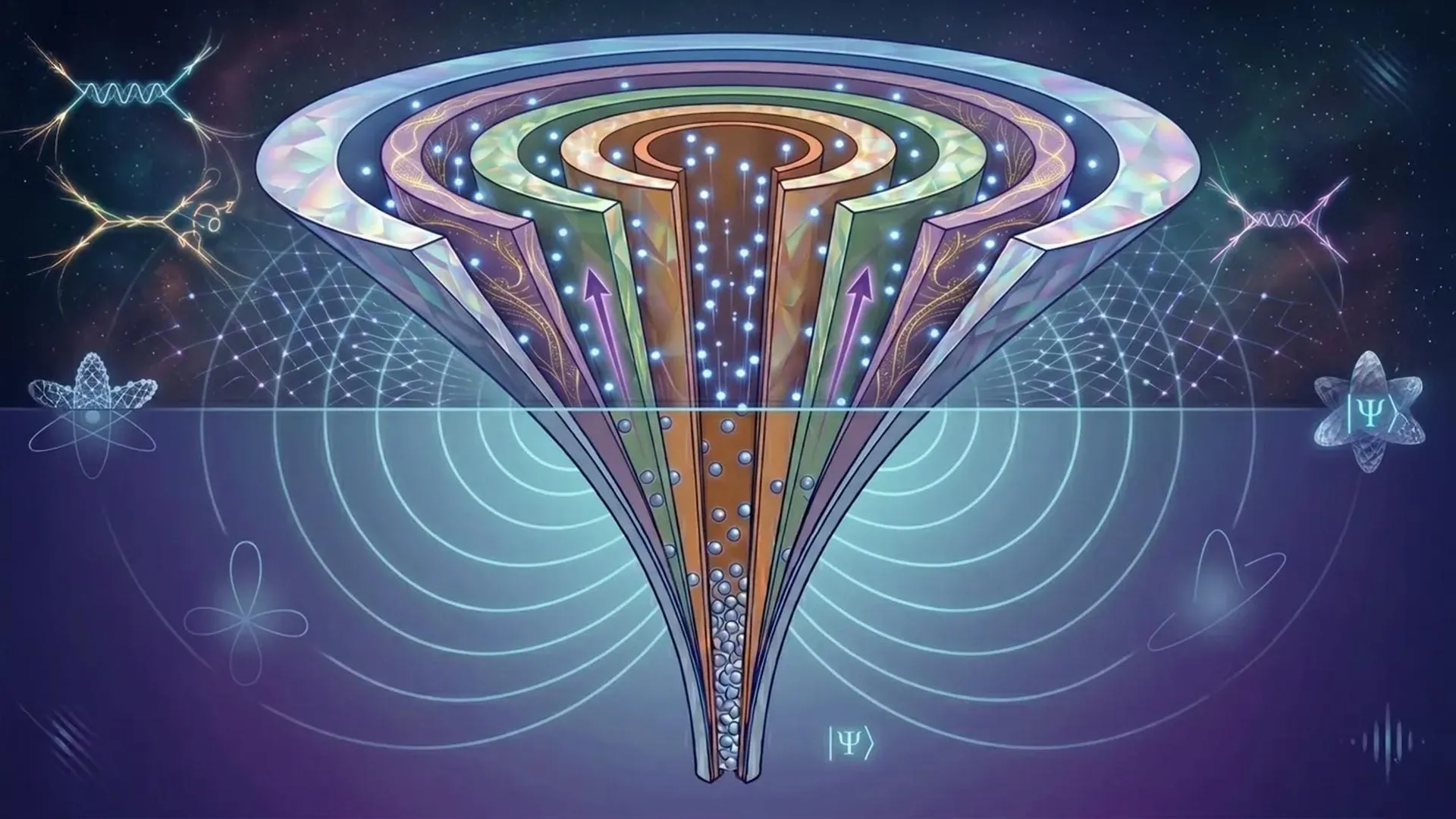 Physicists create a bizarre new quantum state called a fractional fermi sea
Physicists have discovered a strange new state of quantum matter in which ultracold atoms defy familiar organizational rules, forming a highly excited yet surprisingly orderly configuration called a "fractional Fermi sea." The discovery challenges established quantum theories and hints at exotic quasiparticles that scientists have dubbed potential "super-Fermions."
 China Builds Actual Giant Mecha
We're in awe of this absolute unit. The post China Builds Actual Giant Mecha appeared first on Futurism .
 A distant supercluster of galaxies points to self-interacting dark matter
Seven billion light-years from Earth, there is an unexpected cluster of galaxies. It has two regions in the process of colliding with each other with a combined mass of more than two quadrillion solar masses. Given its mass, the distant cluster has been nicknamed El Gordo, the Fat One. What makes it unusual is that it's extraordinarily large for that period of the universe. How did such a large s…
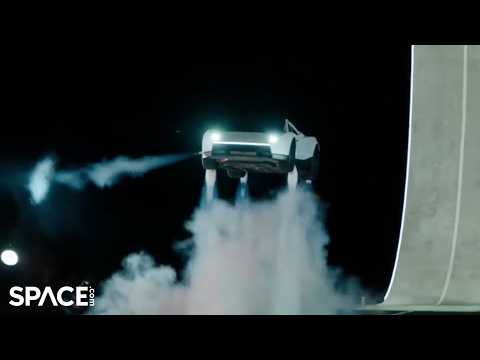 Tesla Unveils 'Flying' Roadster with SpaceX Thrusters
Tesla's new Roadster features SpaceX thrusters designed to give it the ability to fly in short bursts. The vehicle was unveiled at a SpaceX facility in Texas... we live in the future.